|
I’m writing this from our new balcony — a camping chair for me, a small stool for the laptop.
We just moved into our first permanent Berlin apartment. The last place was a shorter-term furnished rental, so we’re short on furniture. But it’s okay.
There’s a small zoo in a nearby park, so the morning has a soundtrack: a rooster, peacocks, the chirping of birds. I’ve got a view into a canopy of London plane trees, warm light beaming through the leaves onto my face. Through the open door behind me, my husband sips his coffee and slowly unpacks boxes.
The year that got us to this balcony was anything but calm.
It was almost exactly a year ago that we pulled the trigger on Berlin. I booked that furnished apartment sight unseen, and it turned out to be the perfect place to begin.
So how did the year actually go? It depends on which version I tell you.
Here’s the version I lived day to day. Everything cost more energy than I’d budgeted — appointments for every bureaucratic step, trying to learn German, hunting for this apartment. A year of it all stacking up.
And underneath all of it, the strain on us. We came close to separating.
Every night, I was scoring the day against the plan I’d drawn up. Is the business where I said it would be? Is my training back? Are we okay yet? Most nights, the answers came up short.
Told that way, the year reads like failure. For months, that was the version I believed.
What finally showed me the problem was a pull-up.
We were training pulling in one of my classes recently, so for the question of the day I asked the room: do you remember getting your first pull-up? I answered too — they’ve never come easy to me, which is why I’ve spent the last year training my back and vertical pulling more than almost anything else. And the athletes who lit up most were the ones who’d always struggled with the movement. Like me.
Then came the work, and the cue I gave them was a reframe. Stop asking whether you have a pull-up. Ask which version you can do — a band, standing under the bar — that hits full range of motion and real time under tension. Then judge the day on whether you put that work in. Focus there, and you arrive at the destination far more easily.
And then, for some of them, it happened. They felt it. Shoulder blades moving. The right muscles switching on. The movement happening where it’s supposed to happen.
Not a pull-up yet. The thing that becomes one.
Here’s the part that followed me home. “Do I have a pull-up yet?” keeps answering no for months — even while the training is working. “Did the work reach the right place today?” can answer yes the whole way there. Same effort, different question, completely different story.
And every question I’d been asking my own year was a version of “do I have it yet?”
|
I was measuring the wrong thing.
|
Not the wrong year — the wrong question. So ask the better one: did the work reach the right places this year?
We’re still here, together — recommitted, not once, but over and over — finding our footing on new ground, in a new language. Unpacking boxes in our first permanent home. Page Street has its first athletes training in it, and my own training loaded in the same system. I’m back on a gym floor, eight classes in. Even this newsletter kept arriving — each issue asking me to keep learning, synthesizing, and living what I write before it lands in your inbox.
Same days. Same effort. All that changed is the question — and the whole year changed with it.
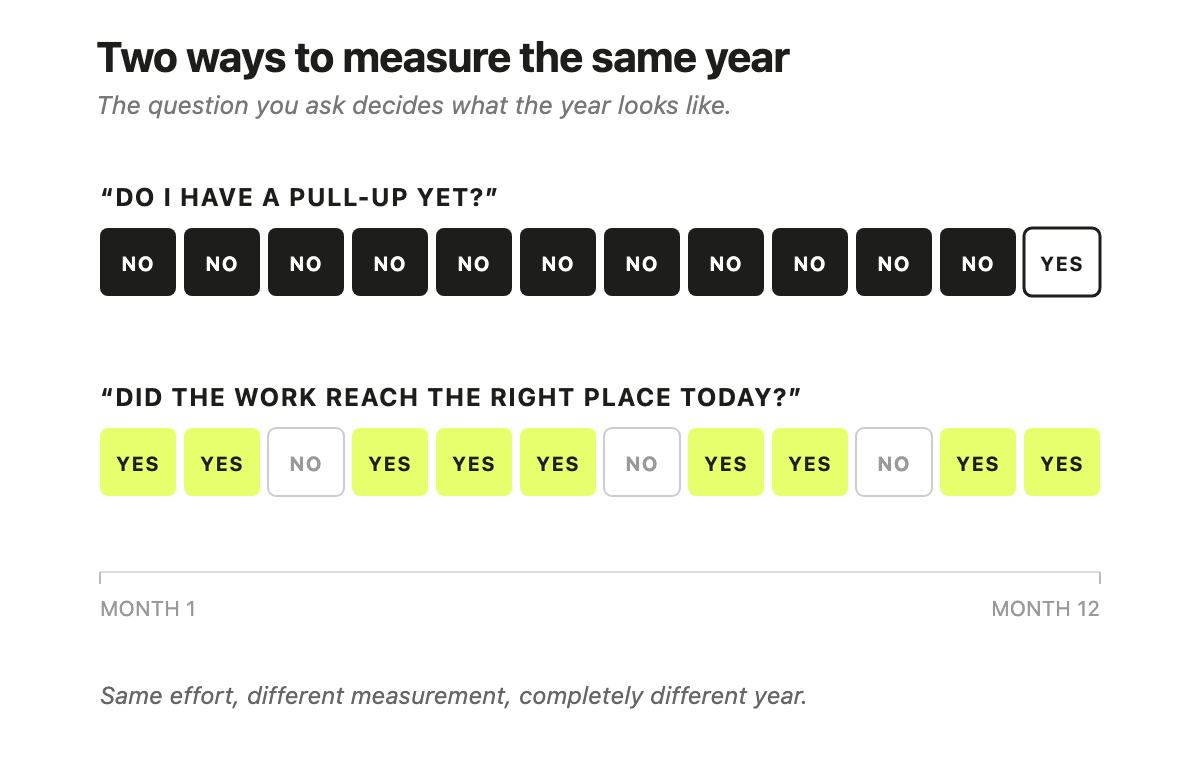
The question matters more than it seems, because the wrong one doesn’t just misread your progress. It attacks the thing that makes progress possible. Ask “am I there yet?” every night, and enough nights will answer no that you stop showing up to ask. Ask “did the work reach the right place?” and an imperfect day can’t end the story — you step back, take stock of the bigger picture, and return to the process the next morning. It’s been a process of returning, and the better question is what made the returning survivable.
That’s the process I’m trying to support with my coaching — at Page Street and on the gym floor. Structure that helps you move through the world, with the safety and freedom to flex and adapt to your real life.
Because everything real seems to arrive this way: not on the timeline you drew up, but through the honest version of the work, returned to again and again, converting out of sight.
And I’d guess this year has asked something like it of you, too. A move, a rebuild, a body, a relationship — something that reads like failure when you ask “am I there yet?”, and looks very different when you ask what the work is reaching.
You’re no stranger to difficult things.
So return to yours as soon as you can. When you can. And ask it the better question.
The rooster is still going somewhere behind the trees. We’re short on furniture and long on boxes. We’re not done. We’re returning.
|
If your year has two versions too, reply and tell me about it — either one. I read every one.
|
—Ivan
|